


Recently, the Ministry of Industry and Information Technology and the National Data Administration jointly launched the 2026 “Model-Data Resonance” initiative. Industry analysts believe that achieving deep synergy between the two hinges on building AI-ready data infrastructure, enabling models and data to fuel each other and drive mutual success. In this context, Caijing Caixin reporter interviewed Yu Yang, Chairman of KeenData Technology, on how “Model-Data Resonance” can promote two-way empowerment between technology and industry.
Yu Yang noted that over the past few years, the parameter scale and reasoning capabilities of general-purpose large models have advanced rapidly. However, when faced with tasks such as anomaly warning for industrial refining units, automotive process optimization, or hospital-assisted diagnosis, these models often fall short because they “don’t understand industry jargon or domain-specific rules.” On the other hand, traditional sectors like energy, manufacturing, and healthcare have accumulated petabytes of data, most of which remain dormant in isolated systems—disorganized in format and inconsistent in standards, making them difficult for algorithms to directly utilize.
“Model-Data Resonance” is precisely about breaking down the barriers between these two parallel tracks. Yu Yang emphasized that building a “data foundation + AI platform + agent portal” three-in-one technical architecture can translate the “veteran expertise” accumulated by enterprises over decades into a language that models can understand, enabling genuine resonance between the two.
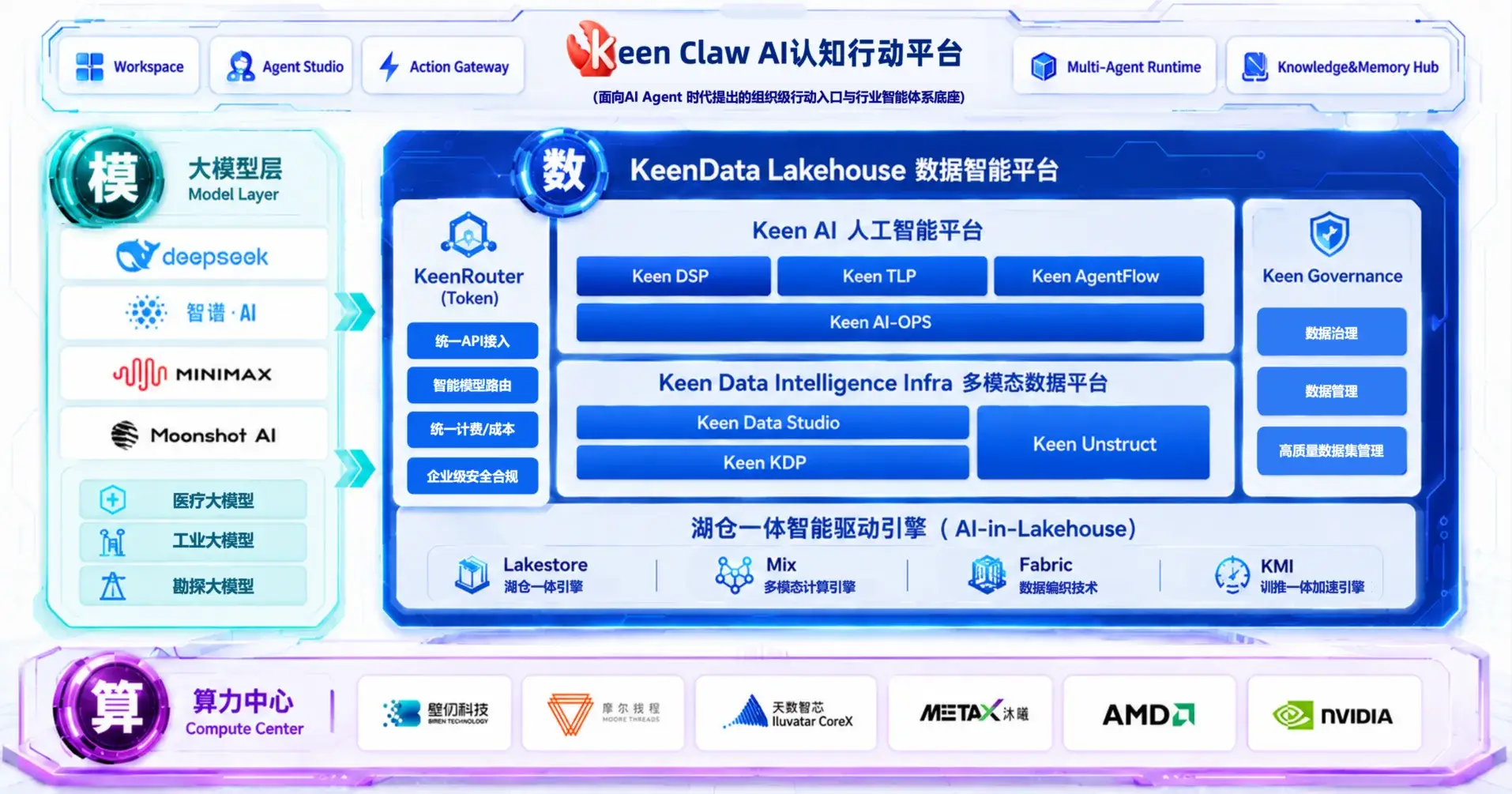
KeenData Technology’s KeenData LakeHouse Data Intelligence Platform: Model-Data Resonance Technical Architecture (KeenData Technology materials, compiled by Caijing Caixin)
Yu Yang stated that if this initiative is successfully implemented, it will deliver triple value: first, leveraging large models’ semantic understanding and code generation capabilities to significantly streamline the development process of traditional AI applications; second, providing models with governed, annotated, and continuously updated high-quality industry datasets to avoid “garbage in, garbage out”; and third, enabling intelligent outcomes to effectively feed back into the real economy—by incubating executable agents in specific business scenarios, delivering tangible cost-reduction and efficiency-enhancing economic value.
From “One-Way Feeding” to “Two-Way Synergy”: Data for AI and AI for Data
To make resonance happen, a fundamental issue must first be addressed: most existing enterprise data platforms are traditional databases or data warehouses originally designed for BI reporting and business systems, primarily storing structured transactional data. The large amounts of unstructured data containing impurities can severely impact model operational efficiency and output quality.
The emergence of the “AI-Ready Data Foundation” has tackled three major technical challenges: first, automated data governance; second, extreme timeliness assurance; and third, unified processing of heterogeneous data engineering from multiple sources.
KeenData Technology positions itself as an “AI data infrastructure provider,” with its core value lying in building capabilities for real-time full-modal data collection, automated governance, and version management tailored for AI training and inference.
On one hand, there is Data for AI. Leveraging high-quality industry data that has undergone standardized governance, combined with deep industry knowledge accumulation, infuses large models with the experiential expertise of industry “veterans.” In the oil industry, historical operational data from refining units helps process optimization models better understand industry boundaries; on automotive production lines, sensor data gives vision large models the “intuition” to identify micro-defects like seasoned experts.
On the other hand, there is AI for Data. The semantic understanding and generation capabilities of large models, in turn, activate dormant data assets. In healthcare, large models can automatically extract disease-specific features from unstructured medical records to build high-quality clinical datasets, feeding back into drug development; in educational settings, they can analyze long-accumulated teaching behavior data to generate personalized learning pathways.
This two-way synergy— “guiding data with models and strengthening models with data”—transforms data from static assets into flowing intelligent fuel.
Deep Integration of Data, Models, and Scenarios to Drive Collaborative High-Quality Industry Development
In industrial practice, realizing “Model-Data Resonance” requires close collaboration among data infrastructure vendors, large model providers, and industry application parties, each leveraging their professional strengths to jointly advance AI technology deployment.
The role of AI data infrastructure vendors is to act as the “translator” and “connector” for enterprise data, while large model providers deliver foundational capabilities. In vertical industries such as manufacturing, energy, and finance, the success of AI applications depends not only on technological sophistication but also, more critically, on the ability to grasp industry-specific needs and deeply mine data resources.
Practices at state-owned enterprises demonstrate that only by combining general AI capabilities with enterprise-specific business processes and knowledge can truly valuable intelligent applications be developed.
Yu Yang added: “In the long run, ‘Model-Data Resonance’ is not just a technological strategy but also an industrial mindset. It emphasizes mutual reinforcement and mutual achievement between data and models—high-quality data enhances model application effectiveness, while intelligent models, in turn, drive improvements in data governance and deeper value discovery.”
Under this new paradigm of mutual empowerment between data and models, enterprises that can pioneer the construction of high-quality data foundations and deeply integrate industry knowledge with AI capabilities will gain significant competitive advantages in the wave of intelligent transformation. The value of this data-driven, model-empowered industrial transformation will gradually manifest across various industries in practical applications.
Editor: Chen Yue
News & Updates
As AI Moves Toward Large-Scale Application, the Long-Term Value of Data Infrastructure Is Emerging
2026 Tomorrow.City · Shanghai Opens | KeenData Supports Global Urban Intelligent Evolution with AI Data Infrastructure

AI Global Competition Enters Data Depth | KeenData Invited to Singapore Industrial Cooperation Exchange Meeting