

As the capabilities of large models steadily converge, the competitive focus of enterprise AI is shifting from “how strong the model is” to “whether it can truly drive productivity.” The core measure of an enterprise-grade Agent's value is no longer how well a demo performs, but whether it can run as a closed loop in real business scenarios, deliver reliably, and stay safe and controllable.
Yet once AI genuinely starts to “take action,” a series of systemic engineering challenges surface: how are permissions safely controlled? how are anomalies intercepted in real time? how are legacy systems connected at low cost? how is the whole execution process fully traceable, auditable, and safely rollable-back? These problems cannot be solved by a single model, nor should every application rebuild the answer from scratch. Competition among enterprise-grade Agents is escalating from point-wise model capability to system-level engineering capability.
01 For Agents to Enter Production Systems, Four Gaps Must Be Bridged
First, the reliability gap: usable in demos, fragile in production. Repeating the same task can branch down different paths, and intermediate state may become polluted; the longer the chain, the more errors accumulate downstream. This is not a problem that swapping in a stronger model can eliminate—it is a matter of consistency and controllability that an engineered system must solve.
Second, the authorization gap: from saying the wrong thing to doing the wrong thing. In the chat era, a piece of maliciously crafted text could at most make an AI say something wrong; once an Agent can actually invoke systems, that same text may become an executable attack. More complicated still, a harmful instruction need not come from the user at all—it can hide inside the web pages an Agent reads, or lie dormant in memory, only to be triggered some time later.
Third, the governance gap: traditional permission systems can hardly cover an Agent in runtime. At runtime an Agent temporarily acquires permissions, spawns sub-agents, and may even act under someone else's identity. Permission systems designed around “people” and “applications” can neither grant access precisely nor assign accountability clearly.
Fourth, the connectivity gap: legacy systems cannot be reached, and business context is missing. Enterprises contain a large number of legacy systems with no callable interfaces; and once an Agent lacks authoritative business context, it rarely stops to ask—it simply delivers a wrong answer with complete seriousness.
These four gaps show that an enterprise-grade Agent cannot stop at “model capability + tool calling.” It needs a system-level foundation that runs through memory, knowledge, orchestration, security, and observability.
02 From Agent Capability to Production-Grade Execution: A System-Level Foundation Is Required
To overcome these challenges, enterprise-grade Agents must move from point-wise capabilities to systematic engineering support, the core being five key capabilities that cover memory, knowledge, orchestration, security, and observability. KeenData's Keen Agentic OS offers a clear view of how these capabilities are put into practice through system engineering.
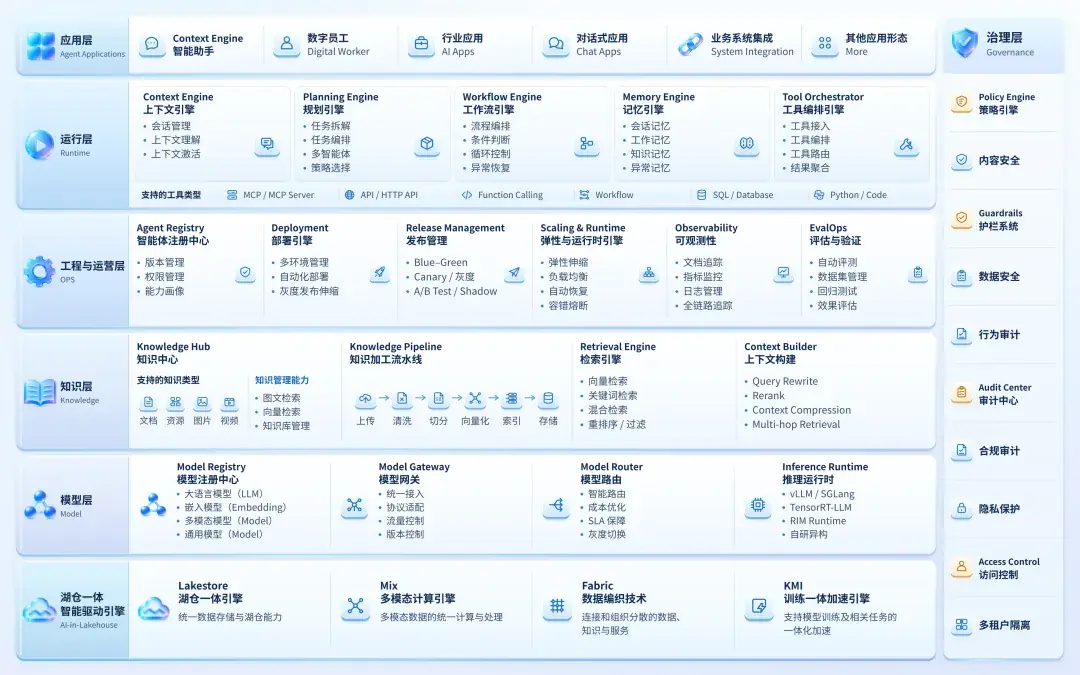
Architecturally, Keen Agentic OS is not a stand-alone Agent development tool but a complete technology stack that connects the underlying data infrastructure, model services, and upper-layer agentic applications. “Memory, knowledge, orchestration, security, and observability” are not five independent functional modules. Through the coordination of three layers—runtime, knowledge, and governance—they form a complete closed loop from context construction and task execution to safety control and operational feedback, providing system-level assurance for Agents entering enterprise production systems.
Long- and short-term memory: breaking the context limit, turning experience into reusable organizational assets
The limited capacity of the context window is the core bottleneck when an Agent runs long-cycle, cross-session tasks. As multi-turn interactions, tool calls, and intermediate results keep accumulating, a finite context can no longer hold the task goal, past decisions, and execution state. Simple truncation or reliance on summary compression easily loses key details and the links between them, causing tasks to drift, state to break, and work to be repeated.
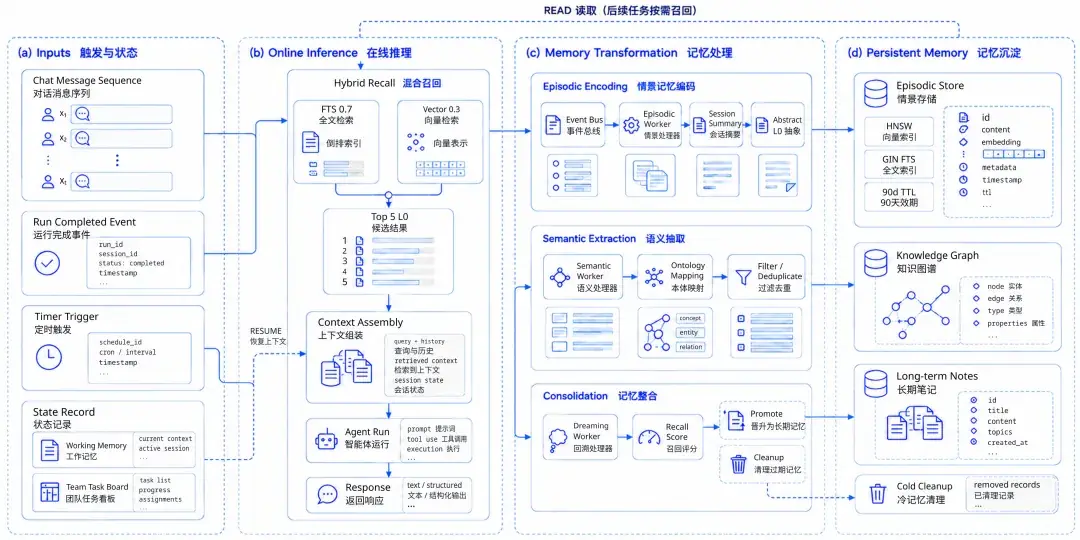
For memory, Keen Agentic OS uses a layered memory architecture and continuous context management to divide Agent memory into three tiers—working memory, episodic memory, and semantic memory—responsible respectively for maintaining the current session context, consolidating historical interactions, and carrying memory across sessions. Combined with hybrid retrieval, proactive context management, and asynchronous background memory extraction, the system can recall key historical information on demand, greatly reducing dependence on compressed summaries. An Agent can therefore keep accumulating and reusing context across long-cycle tasks, which underpins persistent memory and task execution beyond a single window limit.
Ontology-based semantic knowledge base: turning business experience into enterprise knowledge AI can understand, reason over, and reuse
Memory lets an Agent remember history; the ontology-based semantic knowledge base goes further, establishing cross-memory entity links and business semantics. Using the enterprise business ontology as its constraint, Keen Agentic OS defines entity types, attributes, and relationships in a unified way, mapping information such as people, organizations, projects, products, tasks, and events into standardized semantic structures and avoiding entity ambiguity and fragmented relationships.
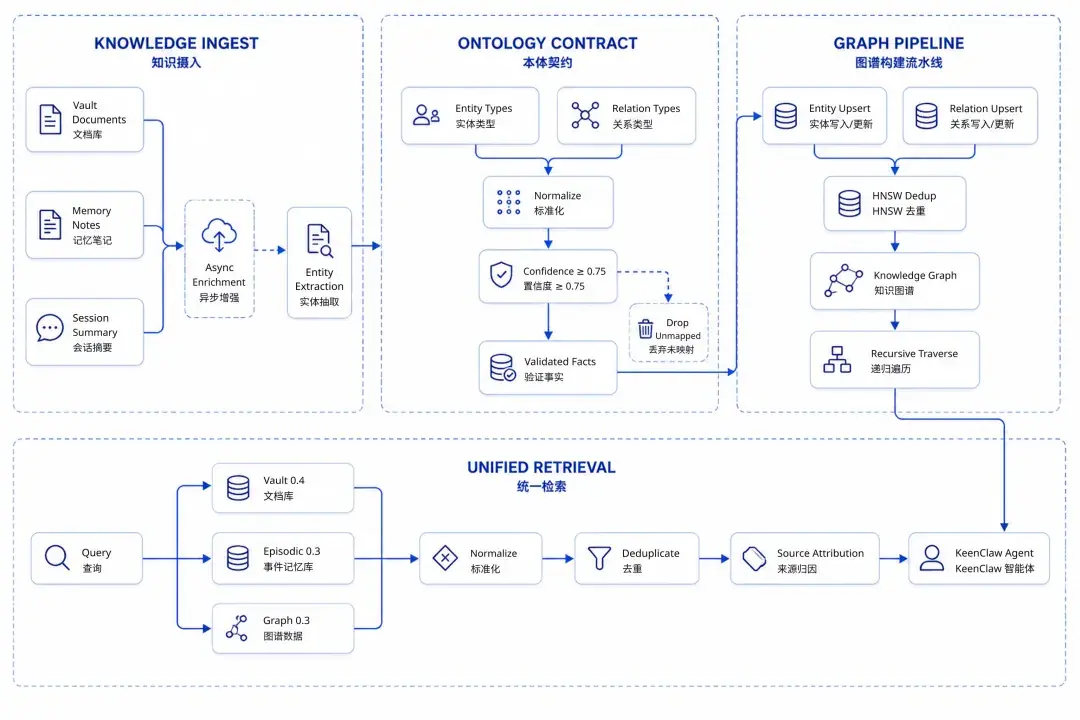
Keen Agentic OS runs an asynchronous background knowledge-extraction mechanism that continuously derives entities, attributes, events, and relationships from memory notes, conversation summaries, and Agent execution traces, and aligns them semantically with type constraints through the enterprise ontology. Combining confidence assessment, entity disambiguation, relationship validation, and incremental deduplication, it builds a strongly typed enterprise semantic knowledge graph that supports multi-hop relationship traversal and continuous evolution. In the retrieval and reasoning phase, the Agent can use entity links and relationship paths to fuse knowledge across documents, reconstruct event chains, and perform multi-hop business reasoning, turning scattered historical information into structured, traceable business context that supports complex task planning and trustworthy decision-making.
Multi-agent collaboration: orchestrating many roles and converging decisions for complex business
Complex enterprise business usually involves process branching, cross-domain information retrieval, and multi-step coordination. Constrained by specialized expertise, context-window capacity, and knowledge coverage, a single Agent can hardly complete an end-to-end task efficiently. Breaking complex tasks apart through the professional division of labor and parallel collaboration of multiple Agents is becoming an important technical path for enterprise-grade agent systems.
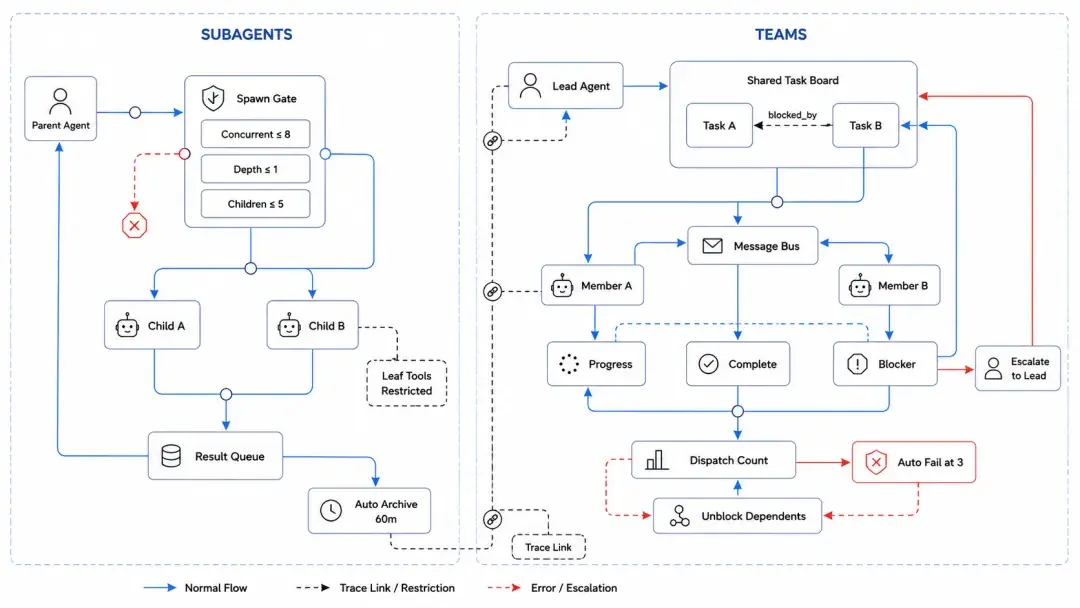
Keen Agentic OS provides two collaboration models—ephemeral sub-agents and standing Agent teams—suited respectively to short-cycle parallel work and long-running, multi-role collaboration. The system decomposes business goals according to task dependencies and dispatches sub-tasks dynamically based on each Agent's role, tool permissions, and domain expertise; a collaboration message bus centrally governs task lifecycles, state transitions, and context passing, supporting serial dependencies, parallel execution, cross-review, and result rollback, which effectively prevents ordering conflicts and message chaos in multi-agent collaboration. Relying on the platform's built-in enterprise ontology and semantic knowledge graph, the business data and analytical conclusions produced by different Agents can be aligned at the entity level and normalized semantically, achieving knowledge interoperability across agents.
In the result-convergence phase, the collaboration hub performs conflict detection, confidence assessment, and information completion on the heterogeneous results returned by the sub-agents, filters out redundant and contradictory information, and fuses outputs from multiple sources. The system can drive multiple agents through advanced collaborative behaviors such as cross-validation, multi-party reasoning, and divided research, assembling fragmented sub-outputs into a complete, traceable end-to-end business result. This deepens the handling of complex business and improves execution reliability, meeting demanding enterprise scenarios such as project disposition, comprehensive assessment, and cross-department processing.
End-to-end safety guardrails: five-layer defense in depth and zero-trust execution isolation
Once an Agent starts calling tools, accessing data, and executing code on its own, safety risk extends from content generation into real business operations. Malicious instructions in web pages, external documents, or historical memory can all influence an Agent's behavior through prompt injection. A single checkpoint cannot cover complex attack paths; what is needed is defense in depth running through identity, permissions, inputs, and execution.
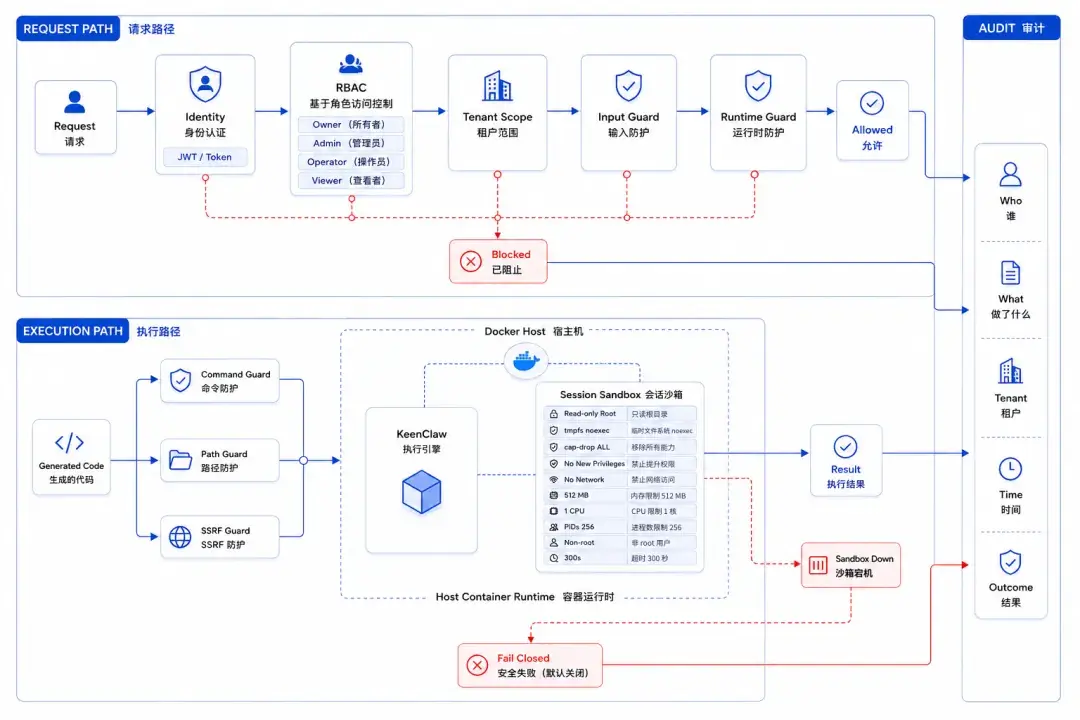
Keen Agentic OS builds five layers of security defense: identity authentication, fine-grained authorization, resource isolation, input/output protection, and runtime guarding and auditing. Each layer enforces its own security checks, putting critical permission constraints into the system's execution path instead of relying on the model's own judgment. For multi-tenant scenarios, the system applies dual checks at the application layer and the data-access layer, reducing the risk of unauthorized data access if a single control fails. A sub-agent's execution permissions are bounded by the authorization scope of its parent agent or the initiating user, and identity linkage together with operation auditing makes the task execution chain traceable.
At the execution layer, Keen Agentic OS gives every session an isolated container configured with non-Root privileges, least privilege, and no network access by default, and sets caps on resource use and execution duration. Unlike the common practice of falling back to the host when a sandbox fails to start, the system adopts a fail-closed policy: when the isolated environment is unavailable, execution is refused and an audit event is recorded rather than degrading to the host, so that safety controls never fail silently because of an environment fault.
Beyond runtime protection, the platform provides two further governance mechanisms. First, human approval gates are configured for high-risk actions such as sensitive data access and critical business operations, which may not proceed without authorization. Second, global safety guardrails apply policies such as sensitive-information protection and content compliance in a unified manner, covering the input and output stages of model calls and of Agent behavior alike, achieving platform-level policy governance. Through multi-layer independent protection, execution environment isolation, approval of critical operations, and end-to-end auditing, security control is extended from constraining model behavior to identity, data, and the execution environment, giving enterprise-grade Agents system-level assurance for safe authorization and production deployment.
End-to-end observability: distributed tracing, execution auditing, and issue root-causing
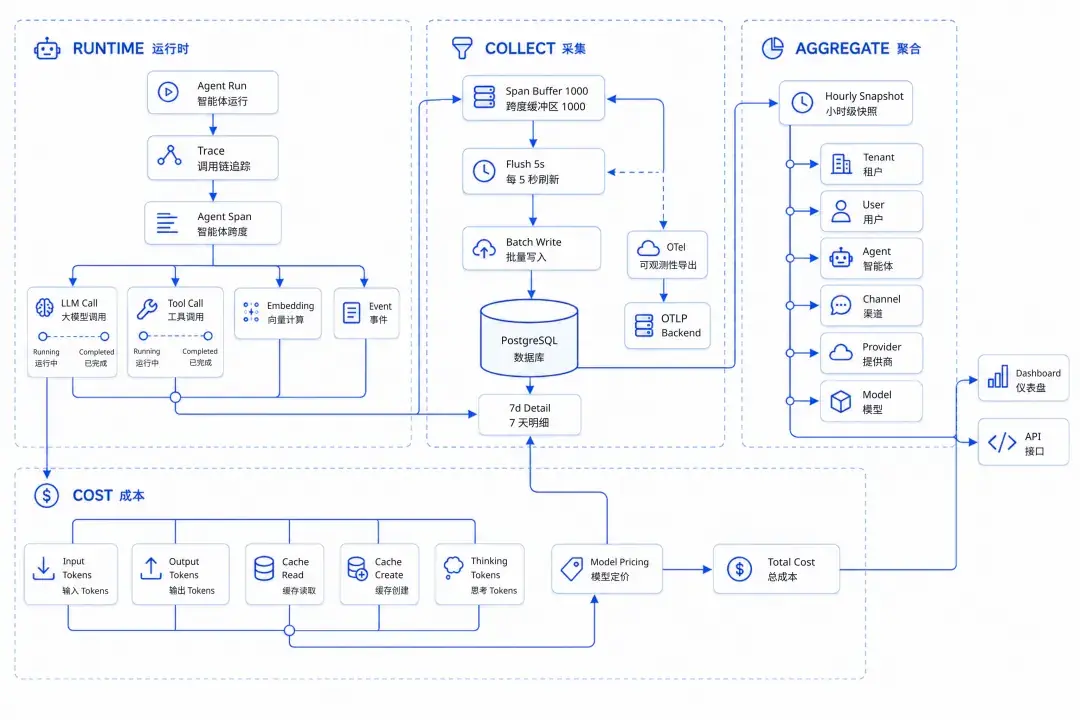
Once an Agent acts autonomously, the questions enterprises most need answered are: who performed each step, when, what was called, what the result was, and whether a problem can be traced back along the call chain. Keen Agentic OS has built-in end-to-end observability: without any additional monitoring stack, it generates an independent call chain for every task, records model calls, tool calls, Agent runs, and safety events as separate spans, and links them to termination reasons, token usage, and pricing information, so that execution can be tracked and costs accounted for.
The system adopts asynchronous recording and tiered retention to keep observation from affecting conversational response time: execution details are retained short-term for troubleshooting and auditing, while aggregated metrics are kept long-term, supporting multi-dimensional analysis by tenant, user, and Agent, with drill-down to individual conversations. The platform also supports exporting trace data through the OpenTelemetry standard, integrating with an enterprise's existing observability stack. Through task-level call chains, correlated execution events, and standardized tracing, the platform turns Agent execution into queryable, analyzable, and traceable operational data, supporting fault localization, behavior auditing, effectiveness assessment, and cost governance.
03 From agents to productivity: building the system-level foundation for enterprise AI at scale
The real breakthrough of enterprise-grade Agents is not simply making AI smarter, but enabling it to complete tasks continuously, reliably, and safely in complex, open, and constrained real business environments. This requires the technology stack to expand from a single model's capability to system-level engineering capabilities spanning memory and knowledge management, multi-agent collaboration, runtime safety governance, and end-to-end observability.
With its systematic architecture, Keen Agentic OS links the complete chain—from context construction, task planning, and collaborative execution to safety control, process tracking, and continuous optimization—moving Agents from “able to understand and respond” to “able to execute, run under control, and deliver continuously.” In essence, this converges the uncertainty of AI into a governable execution chain, and turns point-wise intelligence into a reusable, auditable, and scalable productivity system.
In the future, the core competitiveness of enterprise AI will depend not only on the limits of model capability, but even more on whether data, models, tools, and business processes can be integrated into a productivity system that is governable, reusable, and scalable. This is precisely the new paradigm for enterprise-grade Agents that Keen Agentic OS is committed to building: letting AI go beyond answering questions to truly taking on work and creating business value.
News & Updates