


Currently, China's artificial intelligence is at a critical turning point from technological breakthroughs to industrial implementation. From the State Council's deployment of the "AI+" initiative in 2025 to the joint launch of the "Model-Data Resonance" action by the Ministry of Industry and Information Technology and the National Data Administration in 2026, national strategic signals are becoming increasingly clear: the core constraint on AI at scale is shifting from model capability to data foundation. KeenData Technology, from three dimensions—policy evolution, industrial reality, and technical pathways—combined with frontline practice, explains the necessity and urgency of building AI data infrastructure.
I. Industrial Reality
The Structural Contradiction of High Investment and Low Return
In recent years, the global AI sector has continued to grow rapidly, yet a significant structural imbalance has emerged between investment returns and industrial implementation.
From the investment side, according to Gartner forecasts, global AI-related spending in 2026 will reach $2.52 trillion, a year-on-year growth of 44%. China's large model technology is rapidly catching up in foundational capabilities, with the gap to leading countries narrowing to within six months.
However, from the return side, results have yet to materialize. NTT DATA research shows that 70% to 85% of generative AI projects fail to achieve expected returns; Gartner reports that only 28% of AI application scenarios achieve full success; MIT research further indicates that 95% of generative AI investments have yet to show significant benefits on corporate financial statements.
In response to this industry reality, KeenData Technology Chairman Yu Yang put it succinctly at the Zhongguancun Forum: "Billions of capital continue to pour in, yet most projects yield little results. The root cause is that the data infrastructure supporting AI operations is not yet in place."
This insight stems from his in-depth analysis of the three core elements—compute, algorithms, and data. Compute and algorithms are general-purpose technological capabilities that can be shared and reused across the industry; the key that determines whether enterprise AI can create real value and achieve tangible results is ultimately whether the enterprise's own data engineering system is solid.
II. Policy Evolution
Strategic Deepening from "AI+" to "Model-Data Resonance"
Looking back at national policy direction in recent years, the focus is shifting from "AI-enabled applications" to "synergistic interaction between data and models"—a trajectory that closely aligns with KeenData Technology's strategic orientation.
In August 2025, the State Council issued the "Opinions on Deeply Implementing the 'AI+' Initiative," aiming to promote deep integration of AI with all sectors of the economy and society. The policy focus centered on model capability enhancement, computing power assurance, and application expansion.
In April 2026, the Ministry of Industry and Information Technology and the National Data Administration jointly issued the "Notice on Jointly Implementing the 2026 'Model-Data Resonance' Action," marking a substantive deepening of the policy focus. "Model-Data Resonance" aims to establish a synergistic mechanism linking data quality improvement and model optimization, achieving a virtuous cycle of "guiding data with models and empowering models with data."
Notably, the two-way driving philosophy of "strengthening models with data and governing data with models" advocated by "Model-Data Resonance" is highly consistent with KeenData Technology's long-standing product logic of "Data for AI, AI for Data."
The "Model-Data Resonance" action establishes a seven-layer implementation framework covering 20 key industries including steel, petrochemicals, non-ferrous metals, building materials, industrial machine tools, automotive, medical equipment, power equipment, shipbuilding, aerospace, pharmaceuticals, and software. This is no longer a conceptual initiative, but a systematic implementation plan with clear goals, quantifiable tasks, and defined milestones.
Digital Economy Development Work Priorities: Embedding Data-Empowered AI as an Annual Priority
In May 2026, the National Data Administration issued the "2026 Digital Economy Development Work Priorities," specifically deploying "strengthening data empowerment for AI development," with the goal of developing a batch of benchmark high-quality datasets that meet AI readiness requirements.
This series of policy developments sends a clear signal: the bottleneck for AI industrialization is shifting from the model side to the data side, and the strategic priority of data infrastructure construction has been elevated to an unprecedented level.
III. Problem Examination
Four Structural Constraints and KeenData's Solutions
Against the backdrop of increasingly clear policy direction, AI at scale still faces four major structural constraints—and KeenData Technology is systematically addressing each through its integrated capabilities:
01 Data Silos Hindering Unified Utilization
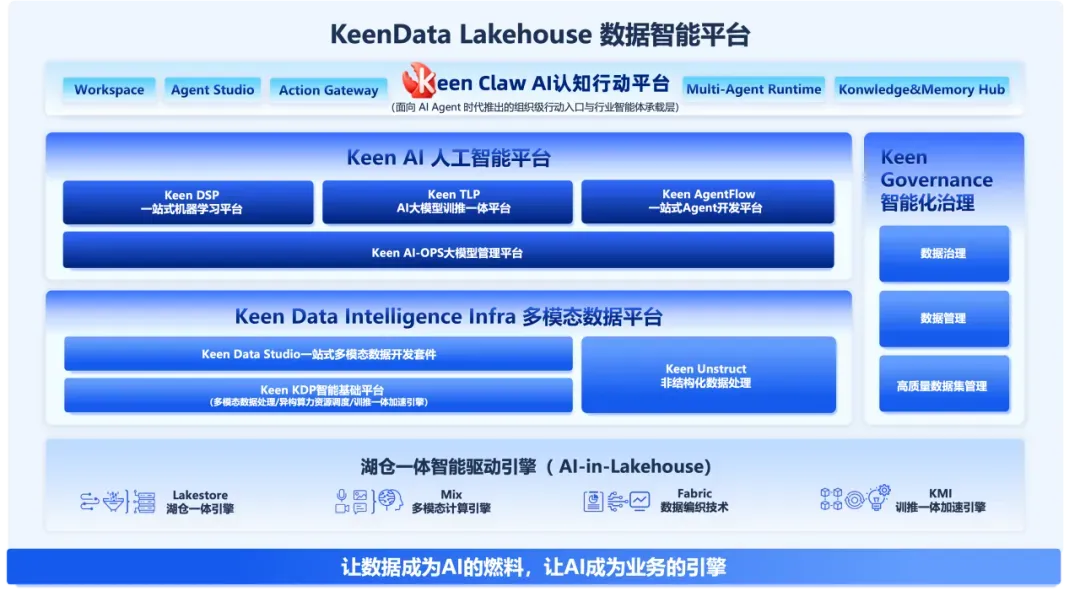
Data in large organizations is typically scattered across dozens of business systems, with varied formats and complex ownership. Chairman Yu Yang has drawn a clear distinction: "Personal AI addresses individual efficiency—data connects and it works. Enterprise-level AI implementation, however, is a complex systemic undertaking that requires AI data infrastructure as a unified foundation." KeenData's KeenData Lakehouse platform, through multimodal data integration and data fabric technology, helps large organizations connect disparate systems, enabling "centralized governance, decentralized empowerment" and providing a unified, compliant data foundation for AI.
02 Data Quality Insufficient to Support Training
Over 70% of the time spent on AI model training is consumed by data cleaning and preprocessing. Non-standardized data annotation and sample bias directly impact model performance. The gap between high-quality datasets and ordinary datasets is the core variable determining model effectiveness. KeenData Technology has built end-to-end high-quality dataset development capabilities covering "data aggregation—cleaning—annotation—quality inspection—version management," combined with intelligent annotation and synthetic data generation technologies, significantly shortening the data preparation cycle and ensuring models are "well-fed and well-nourished."
03 Data Security Hindering Open Circulation
Industries such as government and finance face stringent compliance requirements, with the persistent challenge of being "unwilling, afraid, and unable to share." KeenData Technology, through privacy computing and trusted data space technologies, enables "data available but invisible," unlocking data value within controlled environments, and has supported the implementation of trusted data space projects in multiple cities and pilot demonstration zones.
04 Engineering Gap Hindering Scale Replication
From prototype validation to scaled production lies a vast chasm of engineering complexity. KeenData Technology Chairman Yu Yang emphasizes: "Preparing data for AI is not a simple, one-time process, but a systematic AI data infrastructure engineering system beneath the surface." KeenData Technology provides a three-in-one full-stack solution spanning data foundation, AI platform layer, and intelligent agent entry layer, helping customers bridge the gap from demo to production and achieve scalable replication of AI applications.
IV. Implementation Validation
KeenData Technology's Systematic AI Data Infrastructure Capabilities
As a pioneer in China's AI data infrastructure sector, KeenData Technology's systematic capabilities have been validated across multiple key industries:
- Energy Sector: Built a 1.2PB-level data foundation for a major energy SOE, covering 9 core business domains, integrating 3,727 data standards, compressing operational analysis report turnaround from one week to four hours, and providing compliant, auditable data support for green electricity trading and carbon footprint tracking.
- Financial Sector: By connecting disparate systems and eliminating information silos, supports the development and iteration of AI-driven intelligent risk control models, enabling the scaled implementation of AI agents in quantitative trading, intelligent research, and intelligent advisory services.
- Urban Governance: Deeply involved in the planning and construction of government-side data infrastructure and trusted data spaces, supporting access for over 1,000 data entities and the release of over 2,000 data products, bringing "Model-Data Resonance" to life in urban governance.
In May 2026, KeenData Technology appeared at the 9th Digital China Summit, with Xinhua Net providing in-depth coverage of its pioneering practices in AI data infrastructure construction. Its technological accumulation and practical achievements have earned recognition from multiple authoritative bodies including IDC and the National Data Administration, being selected as a core player in IDC's "China Data Agent Market Landscape" and as one of the first batch of pilot units for trusted data space standards and technical document validation by the National Data Administration.
Conclusion
From "AI+" to "Model-Data Resonance," in the second half of AI at scale, data infrastructure is no longer optional—it is imperative. KeenData Technology will continue to work alongside industry partners to strengthen the AI data foundation, ensuring every model iteration is supported by high-quality data and every AI scenario is backed by a solid engineering system, jointly ushering in a new phase of industrial development in the digital intelligence economy.
Author: Lin Enguo
News & Updates
As AI Moves Toward Large-Scale Application, the Long-Term Value of Data Infrastructure Is Emerging

2026 Tomorrow.City · Shanghai Opens | KeenData Supports Global Urban Intelligent Evolution with AI Data Infrastructure

AI Global Competition Enters Data Depth | KeenData Invited to Singapore Industrial Cooperation Exchange Meeting